

By Scott, N3FJP
Hi All,
The following is off topic, but I want to share my experience with you in the hopes that it will help keep you safe, so Lord willing, you will be able to continue to enjoy our software for a long, long time! Since this group is specific to N3FJP Software support, I am locking this thread on the group, but you are welcome to e-mail me direct with any questions.
Disclaimer:
I am not a professionally trained or definitive source of information on lightning protection and grounding. The recommendations provided here are mostly from my conversations with Perplexity AI and may not be suitable for your application. I disclaim all liability for any damages and / or injury resulting from your use of this information. If you are interest in this topic, I highly encourage you to seek out resources from professionals, including ARRL, for more complete information, tips and recommendations.
Lightning Lessons
Kimberly and I had an adventure with lightning at our house the day after Field Day. We had a very strong strike on our property that damaged quite a few things. I thought I would share the experience and the steps I'm taking to decrease the odds of a future damaging strike. Hopefully you will learn from my prior complacency and ensure your family, house and electronics are as safe as possible!
After having a significant surge exploring its way through our house, taking out TVs, power supplies, wall warts, PCs, monitors, network equipment, antenna switch boxes, etc., (even those behind surge protectors) I am highly motivated to do everything I can to minimize the chance of that ever happening again. It is no joke!
I will let the pictures tell most of the story and then finish up with a summary...
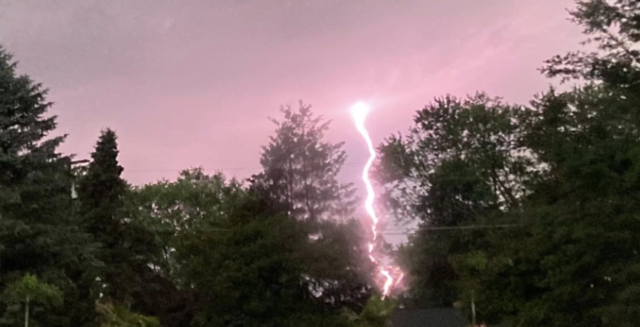
A neighbor happened to catch this shot during the storm. I have no idea if this is "our" strike or not, but it could be. I've experienced that snap and then boom a tenth of a second later a number of times, but this is the first time the snap - boom blurred into one. It was LOUD! Kimberly and I were already down in the basement due to the tornado warning and crazy lighting flying everywhere. I am very thankful we were.
As soon as it hit, circuit breakers flipped, so I ran up to make sure nothing was burning. Thankfully there was no flame, but that burnt electronics smell was everywhere.
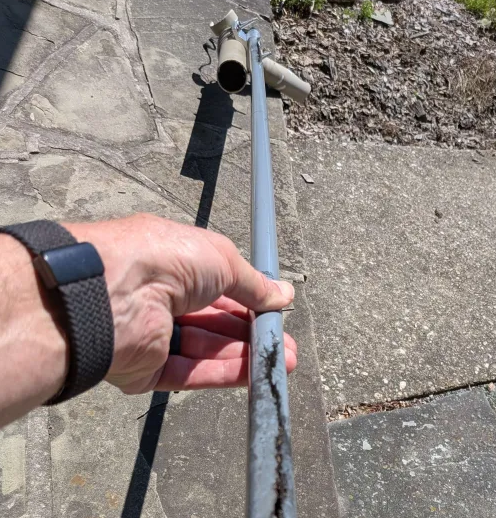
One of the strike's leaders took out my Meshtastic node, that was way up in an oak tree, hanging by a rope that also supports a dipole about 10 feet lower. This node was solar powered and not connected to anything except the Dacron rope, but it sure was attractive to the lightning!
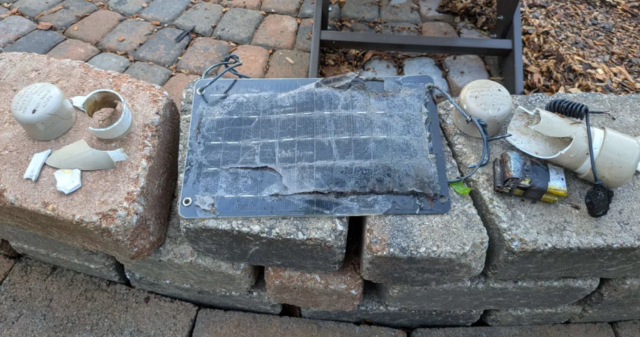
The solar panel and parts were blasted all over the yard. If only our node had been the only damage.
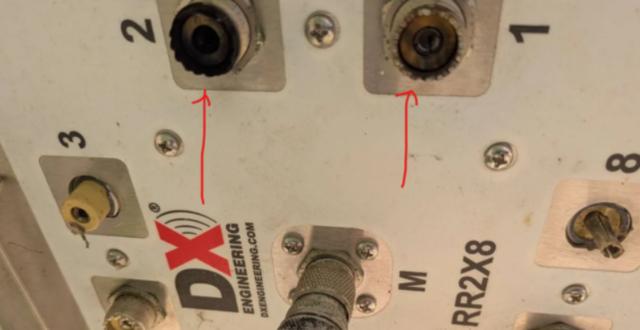
My remote switch box, about 100 feet from our house. Port 2 is my 40 meter NE/SW dipole. The Meshtastic node that got zapped was about 10 ft. above it. Port 1 was the 80 /160 fan. All these antennas were way up in the oak. The switch box was grounded and the coax running to the house was in a glass jar inside, so lightning did not enter our house through the main coax run.
However...

Inside the house, I suspect this is the primary point of entry. The other end of this coax is near my switch box 100 feet away, but it was not in use and it was just laying on the ground. It was not connected to anything at all on either end.
I did not have the shack end in a glass jar. I didn't think it was necessary, since it was not attached to anything on either end, it is mostly underground and encased in a 4" PVC pipe. Only a couple feet of the cable are above ground, a few feet away from the remote switch box. Unfortunately, the house end was laying on the floor in the shack, within a couple inches of a power supply...
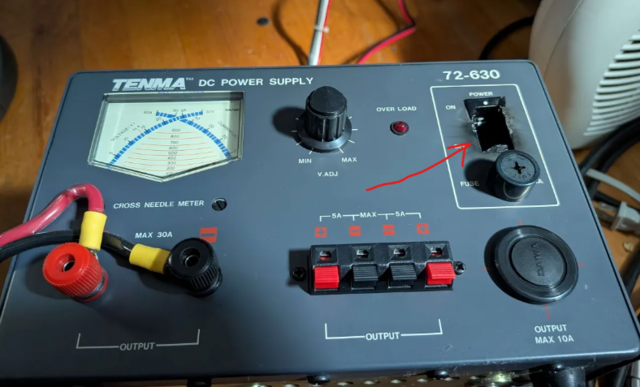
The lightning arced over to the power supply, which was destroyed. The plugged in power supply provided the pathway into the rest of our house electric, ultimately tripping circuit breakers in our circuit breaker box and destroying multiple items, including a TV (not turned on) on the other side of the house that was behind a surge protector. In fact, multiple items behind several different surge protectors / UPS were destroyed.
To sum up...
Lightning is SCARY. Protection is really important, not only for our equipment, but home and personal safety.
We live in a neighborhood that is lightning bait. In the last two years, within a 10th of a mile of our home, two different huge pine trees were hit by powerful bolts that literally exploded the trees, sending pieces of them over multiple neighbor's houses. It was like a bomb went off both times.
We live on fairly high ground relative to the immediately surrounding area. When we moved in to this house and had MANY more trees in our back, there were at least a half dozen individual trees with lightning streaks coming all the way down their bark. There are clay areas back there where the water is very slow to drain, which apparently are highly conductive and lightning enticing.
Our lightning exposure was already above average. Now that MOST of our trees, which served as lightning scrubbers between us and the way storms typically approach are gone, even though our rancher is low profile, I suspect our odds of future strikes have gone way up.
I am by no means a lightning or grounding expert, but here are a couple things that I've learned from this real world experience (or more precisely, have been reinforced)... 1. Be sure your shack ground, house ground and any other grounds you have around your house are ALL tied together.
I was actually very good about grounding all my radio and solar projects, putting in ground rods for each, but they were not all connected together into one unit, as they should have been. I now better understand how everything rising and falling simultaneously prevents arcing inside the house, as well as providing more paths for the lighting to reach ground to quickly dissipate, when that nearby strike inevitably occurs. Even outside TV antennas, outside wireless access points, etc., should be connected to your house ground.
Prior to our lightning strike, our house had one ground rod, a ground connected to the cold water pipe coming from the street and a connection to our natural gas pipe coming from the street, for a total of 3 paths to ground.
Now I have connected four additional ground rods to the house ground using about 100 feet of #6 copper ground wire, for a total of 5 ground rods around the house, plus two utility connections, or 7 paths to ground in all.

As a sanity check, I plugged an extension cord into a wall outlet inside the house and ran it out near one of my ground rods. Using my ohm meter to touch the extension cord ground and ground wire to one of my ground rods, I verified there is a path from the house to the rest of the ground system. There is zero doubt all 7 paths are tied together to the house. Important Safety Warning: If you try this experiment, be very careful to only touch the ground of your extension cord with your multimeter probe (set to read ohms), as the other two wires are carrying your 120V AC current, which could seriously injure you or worse!
2. Entirely disconnect everything well before the storm arrives including coax, power and ground wire is safest.
Grounding is essential (and required by code for equipment in service), but taking equipment out of service and disconnecting everything, including the ground wire, is even better protection. The following is from Perplexity AI:
If your electronic equipment is directly connected to a ground rod that is bonded to the house ground, and there is no surge protector on this ground wire, disconnecting the equipment during thunderstorms is the wisest move for protection.
Here’s why:
Ground rods, even if well-bonded, cannot fully protect sensitive electronics from the extremely fast and powerful energy surges caused by lightning. In fact, a direct or nearby lightning strike can send a surge of energy through the entire ground system, causing all bonded equipment—including anything connected to that ground rod—to experience the same rapid voltage rise.
Surge protectors are designed to absorb and divert transient surges before they reach your equipment, but they are ineffective on ground-only wiring that does not carry power from a plug or panel.
Electrical safety best practices strongly recommend unplugging valuable electronics—including disconnecting any external wiring to ground rods or antennas—before a thunderstorm arrives. This is the only certain way to prevent damage, as surges can travel through any connected wiring, not just through AC power lines.
If your electronic equipment is fully unplugged from all power sources and external wiring (including communication lines, antennas, and ground wires)—effectively disconnected from the electrical system—then that piece of equipment is "out of service" and no longer falls under the NEC's requirements as an active, permanently connected device.
In other words, unplugging and fully disconnecting a portable or movable device prior to a storm is not a violation, because the device is not in use and not considered part of the system in that state.
What is not allowed is disconnecting only the ground wire while leaving the equipment otherwise connected to power or other signal lines; this would defeat protection and create a hazardous situation, violating code.
3. We can not rely on surge protectors. They might help for small surges, but they are overwhelmed by close strikes. Unplug anything you can from wall outlets.
That said, in addition to sensitive indoor electronics, anything outdoors that remain connected during storms should have a grounded surge protector, including antennas and wireless access points, etc. By the way, I did have a grounded, surge protected wireless access point and it did survive, though two PCs were lost, a third damaged and multiple switches were lost, all behind surge protectors. It appears the surge did find its way into our ethernet (or maybe the surge on the AC got them - impossible to say).
4. Monitor for storm activity in your area and disconnect WELL BEFORE the storm arrives.
Touching these ground and coax connections during storm events is very dangerous. If you hear thunder, it is too late. You are in strike range and you risk your life / safety, so don't do it. Equipment is replaceable, you are not.
5. Stay SAFE!!!
Really that's number one. Kimberly and I are still mentally recovering from the strike. Seriously, that really shook us. Had we been touching the wrong device at the wrong moment, using our PCs, etc., or had it struck the house directly and started a fire - who knows? I've never liked lightning when outside, but it never bothered me when indoors - until now.
So, that's my tale. I hope it helps encourage everyone to make your homes as safe as possible. There is only so much we can do about a direct strike, but there is a lot we can do about those glancing blows!
Be safe! 73, Scott N3FJP
https://www.n3fjp.com